Free Online Pool
Groups are assigned after the break.
Play 8-ball pool against the computer or friends
Play American 8-ball in your browser with no download or sign-up. Practice against AI, take turns with a friend on one device, or send a room link to play online.
Clear your solids or stripes and legally pocket the 8 to win. To plan a runout, look beyond the ball in front of you: choose your next shot, decide where the cue ball should finish, and preserve a route to the 8. Start with the controls below, or go straight to the rules and position-play examples.
Choose AI, local two-player, or online pool
Play against AI for a solo game. Choose a difficulty and who breaks. Practice shot-making and cue-ball position without waiting for another player.
Choose local two-player to share a device. Open Local Two-Player on one computer, phone, or tablet. Follow the turn indicator and pass control when the other player is due to shoot.
Choose online play to use separate devices. Open Play Online, create a room, and send its link to your friend. They can join in their browser without an account.
How to aim, shoot, and control the cue ball
Set up an AI game. Choose a difficulty and who breaks. You can change difficulty without restarting. Changing the rules or break order starts a new game and clears the position and shot history.
Aim and set power. On a computer, move the mouse to aim, then click and hold on the table. Drag backward, opposite the shot direction, and release to shoot. The left and right arrow keys make small aim adjustments. On a touchscreen, slide to aim, pull down the power bar, and release.
Set spin. Use the cue-ball control to strike above center for follow, below center for draw, or left or right of center for sidespin. Double-click the control to reset to center ball. Start with small adjustments and compare the cue ball's finish before adding more spin.
Check the result. Before shooting, confirm your group and whose turn it is. After the balls stop, check the shot history or foul message. With ball in hand, place the cue ball before aiming. Review any shot you want to study before restarting.
8-ball rules: the break, solids and stripes, fouls, and the 8
These rules apply to the 8-Ball — American Rules option. League and tournament rules vary, particularly on the break and the 8-ball. Check the rules of the event when playing elsewhere.
The rack and the objective. Each rack has seven solids, numbered 1–7; seven stripes, numbered 9–15; and the black 8-ball. Both players use the white cue ball. Once groups are assigned, clear your group and legally pocket the 8 to win.
The break and group assignment. A legal break must pocket an object ball or cause at least four different object balls to contact a cushion, without a foul. The break does not assign groups. The table remains open until a later legal shot pockets a solid or stripe. On an open table, contact a solid or stripe first, not the 8.
Keeping your turn. After groups are assigned, contact your own group first. Legally pocket one of your balls to continue. If you pocket only your opponent's balls, your turn ends. A foul ends your turn even if you pocket one of your own balls.
Fouls and ball in hand. Missing every object ball, contacting the wrong group first, or pocketing the cue ball is a foul. On a non-break shot, after legal first contact, a ball must be pocketed or at least one ball must contact a cushion. A foul gives the opponent ball in hand anywhere on the playing surface, including after a break foul.
Winning and losing on the 8. Legally pocketing the 8 with your group cleared wins the game. Pocketing it while your group remains on the table, or on a foul, loses the game. The American option also allows you to pocket your last group ball and the 8 on the same shot, provided you contact your own group first, clear it on that shot, and commit no foul.
The 8 on the break. The 8 is respotted rather than counting as an automatic win or loss. Without another foul, the shooter continues on an open table. If the break also includes a foul, the opponent receives ball in hand.
Called shots. You do not need to declare a ball or pocket before shooting.
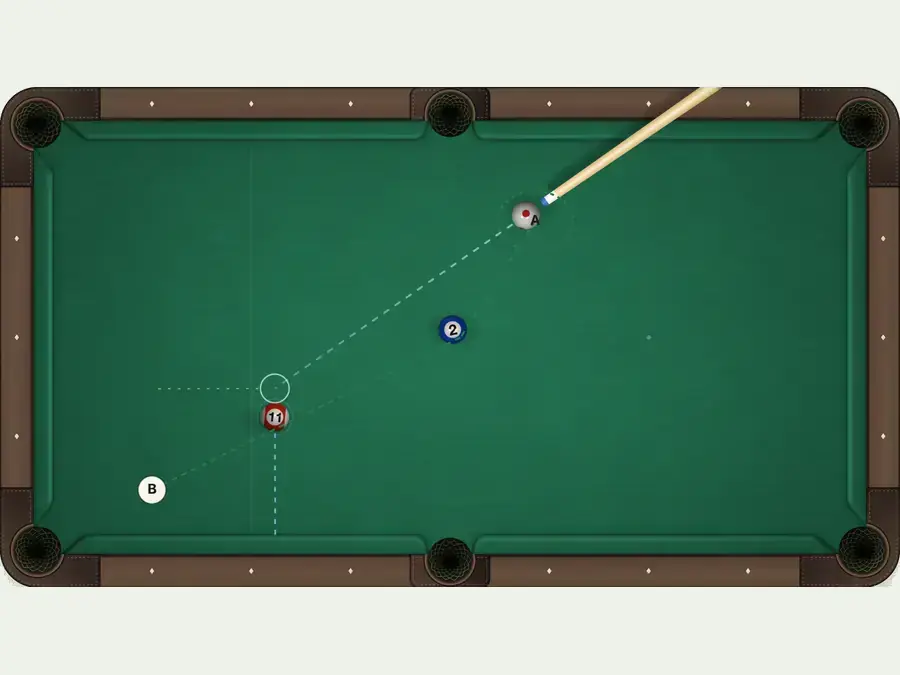
Compare candidate positions: rule out blocked lines first
Ball layout. Assume you are solids and the 2 is your next object ball. A and B are two candidate cue-ball stops after the previous shot: from A the line to the 2 is open; B is near the bottom rail and the 11 blocks a straight hit on the 2. You cannot compare the two spots by cue-ball travel alone.
What to choose. If the last shot can reach A, keep the unobstructed first-contact line, then judge the pocket angle on the 2. B is tight to the cushion and adds blockage work. The diagram shows position only—it does not prescribe stroke, speed, or the actual cue-ball path.
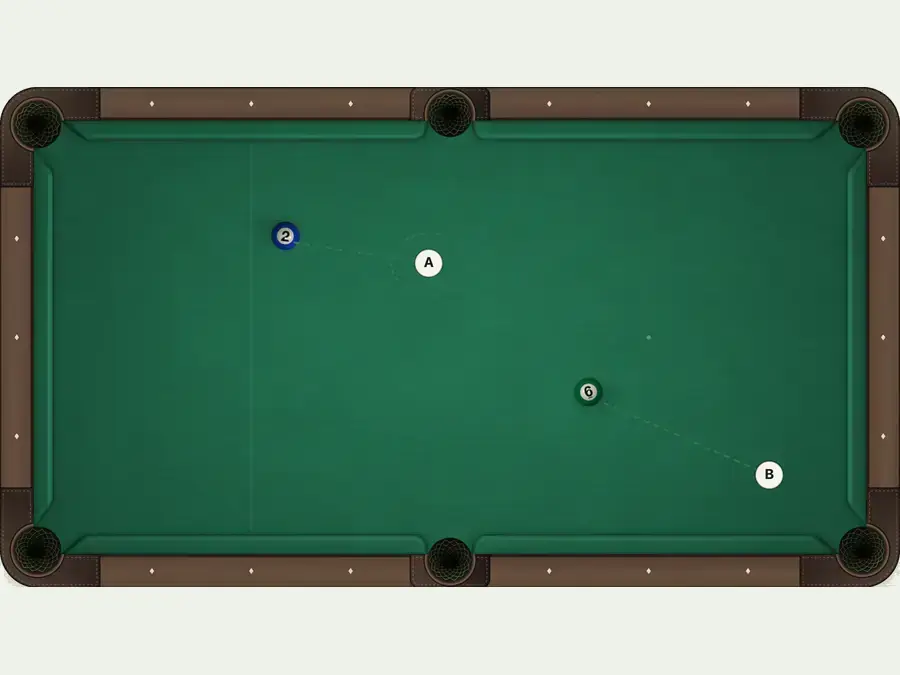
Linking two balls: shot order depends on reachable position
Setup. Assume solids 2 and 6 remain and both are playable. Plan one: pocket the 6, land in A, then play the 2. Plan two: pocket the 2, land in B, then play the 6. A and B are targets to test, not guaranteed outcomes.
How to compare. Check whether the current cue-ball spot supports each plan’s first pocket and position, then compare the next shot’s angle, rail risk, and available stroke. Favor 6-first only if A is reliably reachable and the line on the 2 stays open—not because A is simply closer.
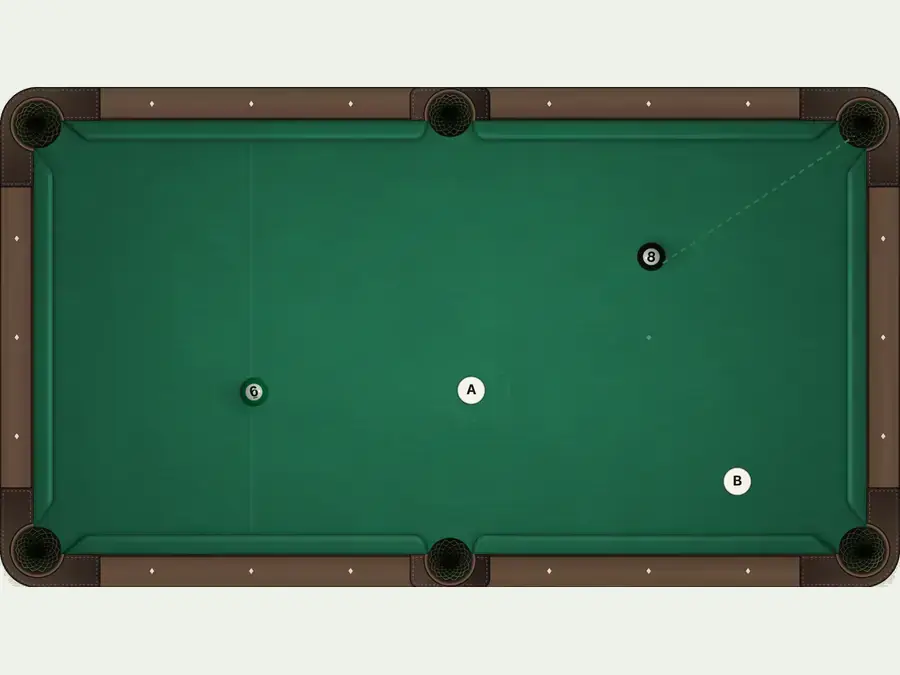
Finishing on the 8: pick the pocket, then the key-ball zone
Layout. Assume only the 6 remains among your solids and the 8 has a clear line to the top-right corner. A sits on the extension of that pocket line and can serve as a post–key-ball zone; B is off that line, so the next angle or pocket needs a fresh look.
Run-out plan. After you fix the 8-ball pocket, decide whether the 6 can leave the cue ball in that zone. A is a target area, not a promise from the current layout; if the route fails, change the clear or the 8 plan instead of forcing power. On this site, clearing your group and pocketing the 8 must be on separate strokes—see the rules section.
Online pool and 8-ball questions
Is this online pool game free, and do I need to download it?
AI, local two-player, and online games are free to play in your browser. No client download is needed. Difficulty settings, spin control, and shot history do not require a paid unlock.
What is the difference between local two-player and online multiplayer?
Local two-player lets two people take turns on one device. Online multiplayer connects players on separate devices. Choose Local Two-Player when you are sharing a screen, or Play Online to join from your own devices.
Do I need an account to play?
No. AI, local two-player, and online games are all available without an account.
How do I play 8-ball online with a friend?
Open Play Online, create a room, and send the room link to your friend. They can open it on their own device and join without signing up. To share one screen instead, choose Local Two-Player.
How do I play on a phone or a computer?
On a phone, slide to aim, pull down the power bar, and release to shoot. On a computer, move the mouse to aim, then click and hold on the table, drag backward, and release. Hide the information panel for more table space on a small screen; reopen it to check the game details or shot history.
Can I play if I am new to pool?
Yes. Start with Beginner AI and center-ball shots at moderate power. Learn to pocket an available ball, then choose a second ball and plan where the cue ball should finish for it. The group display and shot results explain what happened as you play.
How do I change the AI difficulty or choose who breaks?
Choose a level in AI difficulty and select You break or AI breaks. You can adjust difficulty without losing the position. Changing who breaks starts a new game and clears the shot history.
Why am I not assigned solids or stripes after pocketing a ball on the break?
The break does not assign groups in this game. The table stays open until a later legal shot pockets a solid or stripe. Check the group display after that shot; do not infer your group from what went down on the break.
What counts as a legal 8-ball break?
A legal break pockets an object ball or causes at least four different object balls to contact a cushion, without a foul. If you legally pocket a ball on the break, you continue shooting; otherwise, the other player shoots. If the 8 goes in, it is respotted rather than counting as a win.
What if I pocket a solid and a stripe while the table is open?
On a legal shot after the break, the first non-8 object ball in the pocketing record determines your group. The game assigns it automatically, even if both a solid and a stripe go in. A foul leaves groups unassigned.
Why was it a foul even though I hit my own ball first?
After correct first contact on a non-break shot, a ball must be pocketed or at least one ball must contact a cushion. A scratch also makes the shot a foul, even if you pocket an object ball. Check the result message for the reason.
Where can I place the cue ball after a foul?
With 8-Ball — American Rules selected, you can place the cue ball anywhere legal on the playing surface, including after a break foul. Do not overlap another ball. If you switch to Chinese 8-Ball, a break foul limits placement to behind the head string.
Is pocketing my opponent's ball a foul?
Not by itself. If you contact your own group first and commit no foul, pocketing only an opponent's ball ends your turn. Pocketing one of your balls as well lets you continue. The opponent's ball stays pocketed.
Can I pocket my last ball and the 8-ball on the same shot?
Yes, under this game's American option, provided you contact your own group first, clear it on that shot, pocket the 8, and commit no foul. The Chinese 8-Ball option does not allow this: your group must already be clear before the shot on the 8.
Is pocketing the 8-ball on the break an automatic win?
No. The 8 is respotted. Without another foul, the shooter continues on an open table. A scratch or another foul gives the opponent ball in hand.
How do I use follow, draw, and sidespin?
Move the contact point on the cue-ball control: above center for follow, below center for draw, and left or right for sidespin, also called English. Double-click the control to reset. Change one setting at a time and compare the finish; speed, distance, and collision angle also affect the result.
How can I review a shot?
Open Shot History to check the shooter, pocketed balls or first contact, and the result. Review the reason for any foul or turn change, then consider whether your cue-ball position helped the next shot. The record does not include a full trajectory replay or stroke analysis.
What does starting a new game clear?
Selecting New game resets the table and clears shot history. Your rules, AI difficulty, and break-order settings stay selected. The reset cannot be undone. Changing the rules or break order also starts a new game.
Do I have to call a pocket, and are these official league rules?
No called shot is required. The rules on this site may differ from league or tournament rules, especially group assignment, break fouls, the 8 on the break, and pocketing your last group ball with the 8. Check the event's rules before competing. Chinese 8-Ball, 9-Ball, and 10-Ball are separate options; the 10-Ball option also does not require called shots.
Is my game progress saved?
The game attempts to save progress in your current browser so you can return to a saved position. It does not sync across browsers or devices. Private browsing, storage restrictions, or clearing site data can remove the save.
Pool terms: cue ball, solids, stripes, position, and ball in hand
Cue ball and object balls. The cue ball is the white ball struck by the cue. Object balls are the numbered balls it contacts, including the 8. In 8-ball, solids are numbered 1–7 and stripes are numbered 9–15.
Open table and assigned groups. On an open table, neither player has solids or stripes. Once groups are assigned, contact your own group first; when it is clear, play the 8.
Position play, patterns, and the key ball. Position play controls where the cue ball finishes for the next shot. A pattern is the planned order of your shots, and the key ball is the ball you intend to play immediately before the 8. Plan a usable position area rather than relying on an exact stopping point. A cue ball frozen to a cushion can restrict your next stroke.
Follow, draw, and English. With follow, forward roll carries the cue ball onward after contact. With draw, backspin makes it return after contact if enough backspin remains. English means sidespin. Speed, distance, and collision angle affect all three.
Scratch and ball in hand. A scratch means the cue ball was pocketed; other fouls have other causes. Ball in hand is the right to place the cue ball after a foul. The selected rules determine where it can be placed.
Respot and called pocket. To respot a ball is to return it to its designated position on the table. Calling a pocket means declaring the intended ball and pocket before shooting.